
Why Collaboration Became the Path Forward in the Deschutes Basin: 30 Year Anniversary Series
The Deschutes River Basin, and its people, have always been shaped by water.
Giving life to the high desert of Central Oregon, the Deschutes River is distinct from many river systems in the American West. Historically, its cold, spring-fed hydrology provided remarkably stable flows, supporting aquatic ecosystems, fish populations, and human communities across seasons and generations. Long before modern water infrastructure or water, the river sustained Indigenous peoples whose lives and cultures were inseparable from its rhythms.
For Native peoples who have lived in the region since time immemorial, water has long been understood as part of a broader system that connects land, people, and ecosystems. Decisions about water use were made with an awareness of their long-term implications, shaped by generations of lived experience.
As the region developed, that same steady water was redirected to meet a broader set of needs. The Carey Act of 1894 accelerated settlement of the Deschutes Basin in the late 19th and early 20th centuries, driven in part by the river’s reliability in an otherwise arid landscape. Farms, timber operations, and growing towns came to depend on water to survive and thrive. To support this growth, canals were carved into the landscape, reservoirs were built to store irrigation water, and water rights were allocated with the goal of putting the public resource of water to what was then understood as “beneficial use.”
For decades, these systems worked as intended. Agriculture expanded. Communities grew. Water moved across long distances to meet demand. In this context, success was measured by delivery and diversion. Leaving water in the river was rarely part of the equation; the priority for decades was to put as much water as possible to use.
Over time, however, the cumulative effects of these decisions became more noticeable.
Large-scale irrigation development and reservoir operations fundamentally altered the river’s natural flow patterns. In the Upper Deschutes, winter storage and summer releases inverted the river’s historical rhythm. Over time, the river channel was increasingly managed to convey stored water downstream for irrigation until it reached diversion points near Bend and beyond, where most of the flow was diverted into irrigation canals. Hundreds of miles of open canals were essential to delivering water across three counties but at the cost of inefficiencies through seepage into Central Oregon’s porous soils and evaporation under desert conditions.
These altered flows impacted habitat, affected water quality, and limited the river’s ability to regulate and support the surrounding ecosystems. Fish populations declined. Some river reaches experienced low or no flow at all. What had once been a stable, resilient system became increasingly constrained.
By the late 20th century, the basin was facing a familiar Western challenge: water rights had exceeded available supply. At the same time, Central Oregon was beginning a period of rapid population growth. Municipal and industrial water demand increased. Groundwater use expanded, revealing direct connections between aquifers and surface flows. Climate variability added uncertainty, making year-to-year conditions less predictable for the region’s agriculture and rivers
None of these pressures emerged in isolation. And the Deschutes Basin was not alone in facing them.
Across the Pacific Northwest, natural resource conflicts were becoming increasingly visible. Disputes over endangered species, habitat protection, and water allocation elsewhere in the region underscored a recurring pattern: when systems are pushed beyond their limits and decisions are deferred until crisis, the result is often prolonged conflict, litigation, and social division.
Indigenous leaders were watching these developments closely. So were irrigators, agency staff, conservation groups, and local governments. The lesson was not abstract. It was practical. Waiting until a system fails leaves few good options. Planning ahead creates more room to adapt.
In the Deschutes Basin, that realization began to shape a conversation. People with very different perspectives started asking similar questions. How do we meet agricultural, municipal, and ecological needs in a system with little margin for error? How do we improve water reliability for users while restoring life back to the river? And how can we do all this in a way that prioritizes working together?
A critical piece of the answer arrived in 1987, when Oregon passed the Instream Water Rights Act. For the first time, water left in a river could be legally recognized as a beneficial use. This social and legal shift did not undo decades of overallocation. But it provided a foundational tool to streamflow restoration, and for the first time in over a century, the river itself could now be part of the conversation.
That legal change mattered because it aligned with a broader shift in thinking. By the late 1980s and early 1990s, it was increasingly clear that no single group or interest should solve the basin’s water challenges alone. The system was too interconnected. Decisions made upstream affected downstream users. Short-term operational choices shaped long-term ecological outcomes. And the economic, environmental, social costs costs of inflexibility were growing.
Collaboration emerged not as an ideal, but as a necessity.
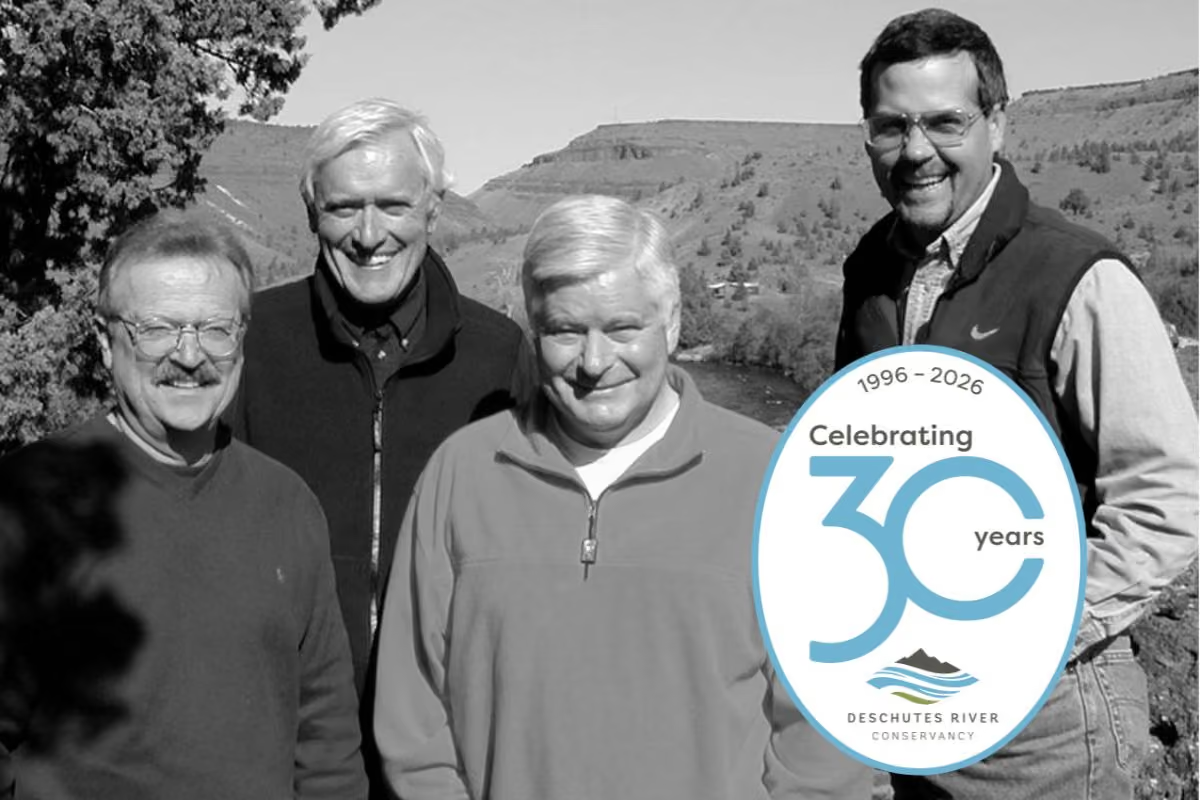
In 1992, this approach took institutional form. Basin leaders—including water managers,Indigenous representatives, conservation organizations, and local irrigation districts—came together to form what was then known as the Deschutes Basin Working Group. The goal was straightforward: create a forum where stakeholders could discuss and address water challenges collectively, with a focus on the long-term health of the river system.
The group’s first project reflected this mindset. Through voluntary negotiation with senior water rights holders, 2.5 cubic feet per second of water, previously diverted for irrigation use, was intentionally left in Tumalo Creek. The amount was small, but the signal was significant. It demonstrated that collaboration could produce direct benefit to the system without undermining existing water uses.
That early effort helped establish a model that prioritized communication, flexibility, and shared responsibility. Over time, this group gained recognition and public support. In 1996, legislation introduced by Senator Mark Hatfield authorized federal agencies to work directly with the organization. In 2005, the name changed to the Deschutes River Conservancy and formalized a consensus-based Board of Directors with the ability to pursue voluntary, market-based approaches to restoring streamflow.
Today, the Deschutes River Conservancy’s work continues within the same reality that shaped its founding. The basin remains overallocated. Climate variability is increasing. Regulatory requirements for fish and wildlife remain in place. And communities continue to depend on water for agriculture, recreation, and growth.
What has changed is how those challenges are addressed.
Rather than waiting for crisis, the basin has invested in planning and strategic action. Rather than relying on one-size-fits-all solutions, it has pursued flexibility. And rather than framing water as a zero-sum conflict, it has increasingly treated it as a shared system requiring shared stewardship.
Understanding how we got here is not about revisiting past decisions. It is about recognizing the conditions that shaped the basin—and honoring the foresight of those who choose a different path.
That choice, made decades ago, set the foundation for everything that followed.
This is where the story of the Deschutes River Conservancy begins.
Read Chapter 2: Proof of Concept: The First Wins that Changed Everything
