
Bend Bulletin: Central Oregon water supplies strained as drought grips region
By Michael Kohn
Persistent drought is reducing streamflow and reservoirs across Central Oregon, threatening water supplies and forcing irrigation districts to limit deliveries or shut down completely.
Nearly all of Central Oregon is now under “extreme drought,” according to the U.S. Drought Monitor, which is updated weekly. A year ago during the same period, most of Central Oregon was experiencing only abnormally dry conditions.
The drought has lowered natural flows in the Deschutes Basin to near historic lows, a condition that has rapidly drained stored water in area reservoirs.
Wickiup Reservoir, one of the key indicators of water availability in the region, was down to 49,770 acre-feet Tuesday, about 25% full, according to data compiled by the Bureau of Reclamation. A year ago at this time, it held 82,228 acre-feet.
The decline has been particularly dramatic because the reservoir was sitting at its historic average as recently as April 1. It is now about 30% below average.
The sharp decline reflects the biggest concern for irrigators across the basin — there simply has not been enough natural water flowing through the system.
Jeremy Giffin, the Deschutes Basin watermaster, said the basin is seeing some of the lowest flow levels in the records he has reviewed.
The natural flow of the Deschutes River at Bend was 976 cubic feet per second during the first half of August, compared with a normal 1,400 to 1,500 cfs. Based on a cursory review of his records, Giffin said that was likely the lowest flow for that period.
The Little Deschutes River has also been hit hard. Giffin said the river is dry between Gilchrist and its confluence with Crescent Creek. He believes this is the first time that has happened.
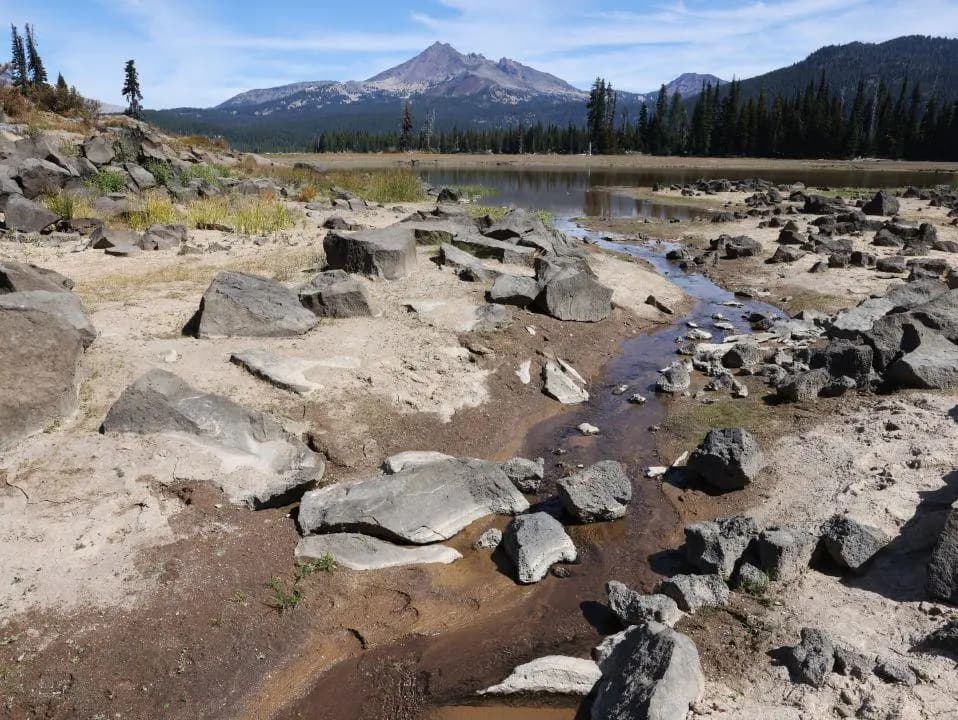
Sparks Lake and other high elevation lakes west of Bend have also been impacted by the drought conditions.
“These lakes are typically replenished throughout the summer by surface flows from higher elevations,” said Carolyn Sufit, Central Region manager with the Oregon Water Resources Department. “However, reduced snowpack has resulted in substantially lower surface flows and limited the amount of water reaching these lakes.”
Sufit adds that drought conditions have lowered groundwater levels, further affecting the lakes and their ability to maintain water levels.
Irrigation Impacts
The lack of natural flow has forced irrigation districts to rely more heavily on stored water, accelerating the drawdown of reservoirs.
“We had one of the quickest and largest pull downs of Wickiup reservoir storage ever encountered,” Giffin said. Record-low natural flows have required irrigation districts to use more stored water to supplement reduced diversion rates.
The consequences are being felt across the irrigation system.
Three Sisters Irrigation District is currently delivering just 20% of its 1895 water right, according to Giffin, the lowest percentage basin watermasters have encountered.
Tumalo Irrigation District has been rotating half of its district every other week and plans to shut down irrigation deliveries for the season on Aug. 31. Its supplemental supply in Crescent Lake is nearly exhausted.
Chris Schull, Tumalo Irrigation District’s general manager, confirmed the planned shutdown but noted that the district has experienced severe shortages in the past.
“The District has a long history of water-short years, including periods when we have had to reduce deliveries, rotate patrons, and end irrigation seasons early,” Schull said.
Major irrigation deficiencies occurred in 1992, 1994, 2004 and 2005, Schull said. What makes 2026 particularly significant, Schull said, is the combination of limited storage, early runoff and rapid depletion of the remaining stored water.
Crescent Lake began July with approximately 20,147 acre-feet of storage. By Aug. 14, it had fallen to 12,899 acre-feet, a reduction of about 36%. Nearly 7,000 acre-feet was released during that period, while storage reports showed essentially no natural inflow.
Across Crane Prairie, Wickiup and Crescent Lake, the three reservoirs collectively went from approximately 158,000 acre-feet of stored water on July 1 to about 106,000 acre-feet on Aug. 14 — roughly one-third of the remaining storage disappearing in six weeks.
“Those are significant numbers,” Schull said.
The state has also shut off all junior Deschutes River diversions between Bend and Redmond to to protect senior water rights. Giffin said no irrigation districts were affected, but dozens of individual water users with private water rights were.
Arnold Irrigation District has been shut down completely because of a lack of natural flow and no supplemental storage remaining.
North Unit Irrigation District has been able to continue serving its patrons because it entered the summer with carryover storage.
Josh Bailey, North Unit’s general manager, said patrons received 1.3 acre-feet of water per acre this year. The district has met that demand so far, but future allocations could be cut depending on demand. He noted that water releases required by the Deschutes Basin Habitat Conservation Plan (HCP) will be met.
“We aim to fulfill all HCP requirements,” Bailey said, “but reservoir levels might drop significantly by season’s end.”
North Unit’s situation highlights the importance of stored water in a basin where natural summer flows are so low.
Bailey said North Unit patrons have received below-normal water allotments for eight straight years. The district is particularly concerned about next year because of the severe drought last winter and the dry summer.
Because the Deschutes is mostly spring-fed, Bailey said winter snowpack and precipitation will heavily influence next year’s supply. The district is preparing for the possibility of a very low allocation, potentially as low as the 0.45 acre-foot allotment patrons received in 2022.
For Tumalo Irrigation District, the effects of the shortage are already being felt by farmers.
The district serves more than 7,400 irrigated acres in the Tumalo area. Those acres support hay, alfalfa, livestock operations, garlic, lavender, carrot seed and other agricultural production.
Forage producers can lose a cutting or see substantially reduced yields if irrigation ends several weeks early. For livestock producers, less locally produced hay and pasture can mean higher feed costs.
Schull said TID has spent years modernizing its system, including piping sections of canal to reduce conveyance losses and get more water to farms.
But infrastructure cannot solve the fundamental problem of a water shortage.
“There is no infrastructure project that can manufacture water during a drought,” Schull said.
Wickiup projections
Giffin anticipates Wickiup could bottom out around 35,000 acre-feet this year, although he emphasized that is only an estimate based on current demand.
Nearly 20,000 acre-feet of Wickiup’s water belongs to the U.S. Fish and Wildlife Service for supplementing flows for spotted frog releases. Officials have also discussed not taking the reservoir too low because of concerns about sediment release.
Oregon state climatologist Larry O’Neil reported in a webinar this week that water scarcity this year is fueled by both warm and dry conditions across the Pacific Northwest, with southern Idaho and northern Washington also impacted.
“Drought conditions were really driven by not only the lack of snowpack but also the large precipitation deficits that accrued across the landscape,” O’Neil said.
O’Neil added that streamflow gauges are at or near record lows across the Northwest and reservoirs are being rapidly depleted. That is likely to create problems for next year’s water supply.
“Across the Pacific Northwest, we’re substantially depleting our reservoir storage, and now we’re getting into the later part of August and September, and so reservoirs are being emptied out, and there’s little hope for carryover into the next water year.”
Photo: A trickle of water runs out of Sparks Lake on Wednesday where a wide channel used to exist. (Dean Guernsey/The Bulletin)
