
Bend Bulletin: Hatchery fish fuel strong steelhead returns in Upper Deschutes Basin
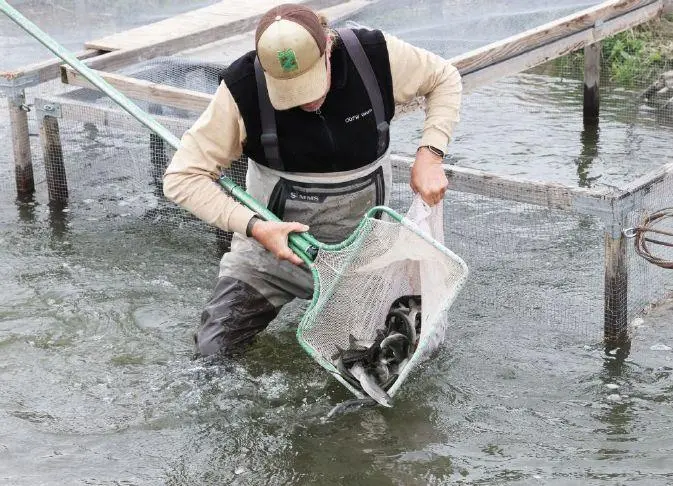
Photo: Mark East with ODFW releases Steelhead smolts that were raised at the Wizard Falls Fish Hatchery into McKay Creek in Prineville on Tuesday. (Dean Guernsey/The Bulletin)
By Michael Kohn
The Upper Deschutes Basin is seeing one of its strongest steelhead returns in years, but the comeback is being driven almost entirely by hatchery fish, state biologists say.
Steelhead returns above the Pelton-Round Butte dam complex remain high, though this year’s numbers are slightly below last year’s record. As of mid-March, 884 adult summer steelhead had been passed upstream for reintroduction, making it the second-highest total on record.
However, the increase is largely the result of management decisions rather than a surge in wild fish.
“The increase over the last two years is primarily driven by a new adaptive management strategy,” said Jerry George, a fish biologist with the Oregon Department of Fish and Wildlife.
State and tribal biologists have been passing surplus broodstock steelhead from Round Butte Hatchery above the dams to boost spawning numbers, George said.
About half of the fish transported upstream are surplus hatchery broodstock, with the remainder consisting mostly of hatchery-origin fish released earlier as juveniles. Only four of the returning steelhead identified so far are of wild origin.
The imbalance is consistent with recent returns. In 2024, more than 700 steelhead reached the upper basin, but only three were naturally produced, according to conservation groups tracking the reintroduction effort.
“The hope is to increase the number of wild fish in future years by taking advantage of strong hatchery returns, when they occur,” George said.
Early signs of success
On the ground, restoration groups say they are beginning to see signs that those hatchery fish are successfully spawning in restored habitat.
“We’ve seen some really good spawning activity from those fish this year — in places where we hadn’t seen it before,” said Jason Grant, a restoration specialist with the Deschutes Land Trust.
Grant said steelhead spawning has been documented on multiple Land Trust properties, including along Whychus Creek and the Crooked River, particularly in areas where floodplain restoration work has been completed in recent years.
At Ochoco Preserve, for example, spawning activity has increased within a restored stretch of river completed in 2022, he said.
“Within about a mile section where we did that restoration, we’ve seen good spawning activity,” Grant said.
He emphasized that nearly all of the fish observed spawning are hatchery-origin, either released as juveniles or transferred as surplus broodstock — underscoring the early stage of the reintroduction effort.
“This is the starting point,” Grant said. “Getting fish on the spawning grounds is how you begin to build toward natural production.”
Grant added that redband trout — a native resident species — are also showing encouraging signs in restored areas.
“We’ve also seen some really good spawning activity of redband trout on that same property, which we hadn’t seen before either,” he said.
Ocean conditions
Local anglers and guides say the recent uptick in steelhead aligns with what they’ve seen, though they caution that ocean conditions — not just river management — play a major role in survival rates.
“In the last three years, we’ve had an uptick every year in the number of steelhead coming back,” said Peter Bowers, owner of Patient Angler Fly Shop in Bend. “That, in my opinion, doesn’t have as much to do with the water they come back to as much as the ocean conditions.”
Bowers said warming ocean temperatures, pollution and overfishing can all affect whether steelhead survive their time at sea and return to Central Oregon rivers.
While steelhead draw much of the attention, resident fish populations in the Upper Deschutes appear relatively stable, both in size and numbers, he said.
“As far as I’ve seen, it’s been pretty healthy fish and the same numbers as usual — nothing out of the ordinary,” Bowers said.
Largely stable numbers
Biologists have been surveying and counting steelhead egg nests, known as “redds,” in Whychus Creek, the Crooked River, and McKay and Ochoco creeks as part of a broader monitoring effort.
Fish populations across the basin are showing mixed but generally stable trends, according to the latest update.
George said the Metolius River redband trout population remains steady, with spawning numbers closely tracking last year’s totals.
“The Metolius redband trout population is stable, and the number of spawning adults is tracking very close to 2025,” he said.
Bull trout numbers in the Metolius River and Lake Billy Chinook declined in 2025, falling about 25% from the previous year. Despite the drop, the population remains healthy after reaching a record high in 2022, George said.
Crooked River redband trout populations are considered fair, while mountain whitefish numbers are strong, easing concerns following extreme runoff conditions last spring.
High flows tied to flood control releases from Bowman Dam raised fears of gas bubble disease, which can injure or kill fish when water becomes supersaturated with dissolved gases.
“We were worried that they might both take a hit after the extreme runoff last spring,” George said.
Many of the surplus hatchery fish have been released into the Crooked River, where anglers have reported catching tagged fish. Officials reminded the public that steelhead in the upper basin are protected and must be released immediately if caught.
Biologists say the long-term goal remains establishing a self-sustaining population of wild steelhead in the Upper Deschutes Basin, though that objective remains years away.
Read more at: https://bendbulletin.com
