
Bend Bulletin: Modern irrigation system helps Three Sisters Irrigation weather severe drought
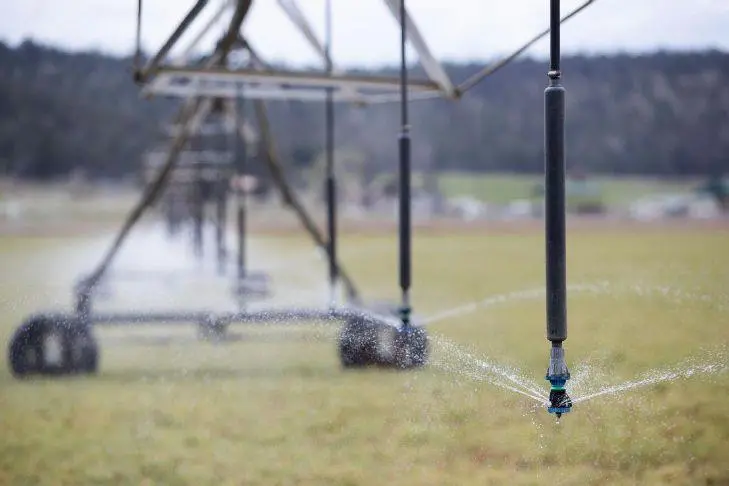
Photo: A pivot irrigation system waters a field that Ted Netter farms in Terrebonne on Friday. Netter said he uses low density nozzles to limit water loss due to evaporation. (JOE KLINE/The Bulletin)
By Michael Kohn
As drought conditions intensify across Central Oregon, one irrigation district may be better positioned than most to withstand a difficult water year — even as supplies run critically low.
The Three Sisters Irrigation District, which serves farms near Sisters, is facing what officials say could rival the drought conditions of 1977. But decades of investment in water conservation — particularly converting open canals into a pressurized pipe system — are helping stretch a limited supply further than in many neighboring districts.
“This is shaping up to be a very difficult water year for our community,” said district manager Emilia Ellington. “But we’re doing everything we can to manage a very limited supply as fairly and responsibly as possible.”
The district relies almost entirely on snowmelt from Whychus Creek and does not have a reservoir, making it highly dependent on winter snowpack. This year’s snowpack is well below normal, raising concerns about how long water will last into the growing season.
Even so, the district’s modern infrastructure is expected to make a difference.
Unlike traditional open canals, which can lose significant amounts of water to seepage and evaporation, TSID’s piped system delivers water more efficiently directly to farms. That efficiency could help make better use of what little water is available.
Ellington said, patrons with senior water rights are expected to receive enough water for at least one cutting of hay, with further allocations dependent on how the summer unfolds.
Across Deschutes County, conditions are worsening rapidly. Snowpack in the Upper Deschutes Basin is just 7% of normal. Dry soil conditions are also worsening — about 98% of the county is experiencing some level of drought, with more than half classified as severe.
For farmers like Ted Netter, those conditions are already shaping expectations for the season.
“Our snowpack is the lowest that I’ve ever had to personally deal with as a farmer in the district,” Netter said.
Still, he said the district’s investments in efficiency give farmers tools to adapt.
“We’ve made a lot of efficiencies that, if we’re smart, we can utilize well what we have,” he said.
Because the system is pressurized, many farmers can irrigate more precisely and avoid some of the losses common in older canal systems. That could prove critical in a year when water supplies are limited.
But the district’s structure also comes with limitations.
Like other users on Whychus Creek, TSID farmers depend on the timing of snowmelt, with no way to store water for later in the season. A warm spring could cause runoff to come too quickly, leaving less water available during peak summer demand.
“If it comes off slow and easy, then we’re going to be able to maximize our use,” Netter said. “But if it comes off fast, we could lose a lot of what we would normally have later.”
Netter estimates that, under a worst-case scenario, water deliveries could fall to around 30% of normal by mid-June.
Some farmers have supplemental groundwater wells to offset shortages, but many do not. And even for those who do, the added cost can be significant.
“When I turn on my supplemental well, it increases the price of my hay by $25 a ton,” Netter said.
In a typical year, Netter aims for at least two cuttings of hay to break even, with a third cutting improving profitability and soil health. This year, that outcome is far from guaranteed.
Even with its efficiency advantages, TSID is not immune to drought. Environmental requirements to maintain streamflows for fish in Whychus Creek further limit how much water can be diverted for irrigation.
Still, the district’s long-term investments may soften the blow compared to systems that still rely heavily on open canals.
“The biggest thing is just using the water you have as efficiently as possible,” Netter said. “And that’s where we’re in a better position than we used to be.”
District officials say they will continue monitoring snowmelt, streamflows and weather conditions in the coming weeks. For now, they caution that while infrastructure improvements help, they cannot fully offset a year with so little snow.
“The outlook right now is challenging,” Ellington said.
Read more at: https://bendbulletin.com/2026/04/16/modern-irrigation-system-helps-three-sisters-irrigation-weather-severe-drought/
