
Bend Bulletin: Wickiup Reservoir to see rapid drawdown amid drought
By Michael Kohn
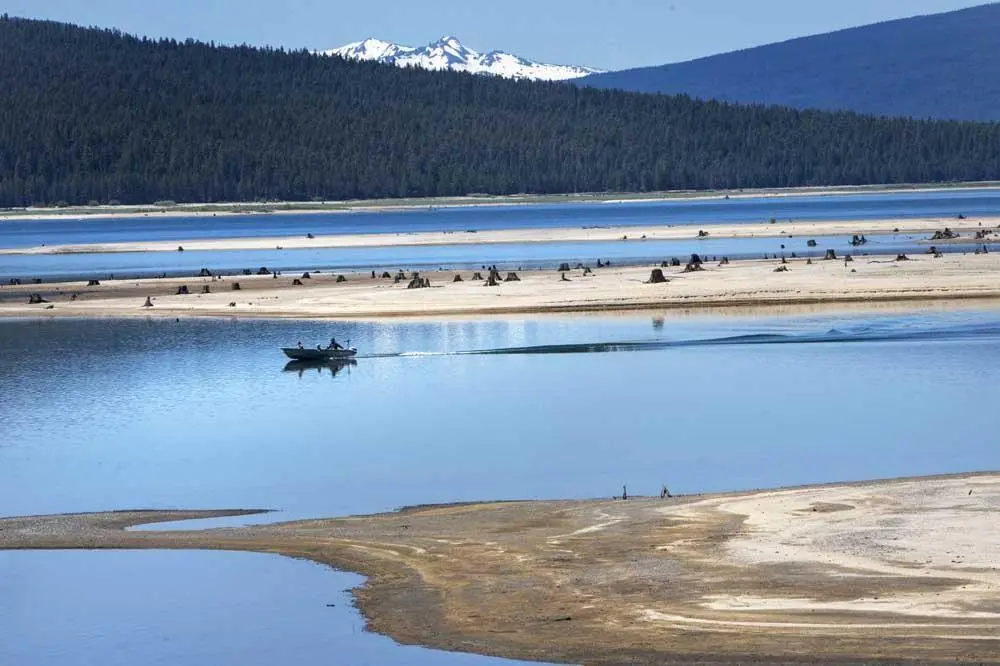
Wickiup Reservoir is expected to fall to extremely low levels this fall as water managers balance the needs of Central Oregon farmers with required flows for the threatened Oregon spotted frog in the Upper Deschutes River.
The reservoir’s decline comes after a summer of severe drought and some of the lowest natural streamflows water managers have recorded.
For farmers who rely on Wickiup Reservoir, the drought has meant another year of reduced water supplies.
North Unit Irrigation District set its water allotment this year at 1.3 acre-feet per acre, compared with a typical full allotment of two to 2.25 acre-feet, said Josh Bailey, the district’s manager.
“This is our eighth year of subpar patron allotments,” Bailey said. “It’s very challenging.”
Bailey said the district plans to shut off irrigation water Oct. 9 as it begins several construction projects.
Stepping down releases
Jeremy Giffin, Deschutes Basin watermaster, said water releases from Wickiup are being reduced as part of a plan to lower flows through October and eventually reach the minimum release required under the Deschutes Basin Habitat Conservation Plan.
The U.S. Fish and Wildlife Service recently released about 15,000 acre-feet of water it had stored in Wickiup over roughly seven to eight days, Giffin said. During that period, managers maintained flows at Benham Falls at about 1,300 cubic feet per second.
Flows have since been reduced to 1,200 cubic feet per second and are expected to remain there for several days before dropping to 1,100 cubic feet per second through Oct. 4.
Managers then plan to rapidly reduce flows, reaching a minimum release from Wickiup of about 103 cubic feet per second on Oct. 16, Giffin said.
The exact bottom of the reservoir remains difficult to predict because irrigation demand can change quickly with the weather.
“When the weather changes, irrigation district demand drops,” Giffin said. “Every day someone calls and says, ‘I don’t need that much water.’ Well, that changes the trajectory quite a bit.”
Minimum levels
Based on the current ramp-down schedule and weather outlook, Giffin said he anticipates Wickiup to not fall below 20,000 acre-feet.
He emphasized that the estimate is difficult to make because weather and irrigation demand can change the reservoir’s trajectory quickly.
That would still leave the reservoir substantially lower than last year, when it bottomed out at about 65,910 acre-feet, according to water-management records cited by Giffin.
The reservoir reached much lower levels during the drought earlier this decade. When reservoir levels dropped to “dead pool,” the Deschutes River turned a shade of green due to sediment running out of the reservoir.
Since then, water managers have artificially set a floor of about 2,500 acre-feet in an effort to mitigate sediment and turbidity problems when reservoir levels get extremely low.
As the reservoir declines, however, some turbidity is possible, Bailey said.
“Of course we don’t like that,” he said. “But it’s just the nature of operating this type of facility.”
Strong winter needed
Wickiup began the 2026 irrigation season with more than 180,000 acre-feet of stored water, Giffin said. With the reservoir expected to end the season at a fraction of that level, he said the basin will need a strong winter, including substantial snowpack and precipitation, to rebuild supplies for next irrigation season.
“If we don’t have a very robust winter with both snowpack and precipitation, we could be in uncharted territory next irrigation season,” Giffin said.
That could mean earlier and deeper water curtailments for farmers, Giffin said, with North Unit Irrigation District among the districts of greatest concern because of its reliance on Wickiup Reservoir.
Bailey said farmers are already watching the winter forecast closely.
“There’s a lot of concern amongst the patrons about what next year is going to look like and what kind of winter we’re going to have,” he said.
Habitat conservation
Water released from Wickiup also helps maintain flows in the Upper Deschutes River for Oregon spotted frog habitat. Conservation projects completed by irrigation districts contribute water toward expected fall flows, according to the U.S. Fish and Wildlife Service, which coordinates water management with Deschutes Basin irrigation districts under the Habitat Conservation Plan.
“Our partnership with the irrigation districts is especially important in a drought year like this,” Emelie McKain, Bend field supervisor for the U.S. Fish and Wildlife Service, said in a statement.
“Despite challenging drought conditions, collaboratively meeting both upper Deschutes flow needs and agricultural needs in the basin is testament to the Habitat Conservation Plan and basin partnerships working in action,” McKain added.
Giffin expects the reservoir to reach an equilibrium at or around Oct. 7, when the amount of water naturally flowing into the system is roughly equal to the amount being released. He estimates the natural flow at that point could be between 450 and 600 cubic feet per second.
Water managers will continue coordinating releases through the remainder of the irrigation season. Under the Habitat Conservation Plan, flows released from Wickiup will be at least 100 cubic feet per second during the winter months.
