
Bend fish rescue saves more than 8,000 at Lava Island Falls
By Michael Kohn
Over three days last week, an annual fish rescue effort at Lava Island Falls in the Upper Deschutes netted and released more than 8,000 fish.
A total of 8,113 fish were recovered from the side channel at Lava Island Falls, which dries up each October due to Wickiup Dam operations. The total included 6,466 rainbow trout, 37 brown trout, five mountain whitefish, 1,578 sculpin and 27 kokanee.
Ben Briscoe, a field biologist with Mount Hood Environmental, the consultancy hired to lead the project, said the number of fish recovered this year was “within the range we normally see each year.”
Typically, around 6,500 to 7,000 fish are recovered each year. Last year was an exception, when 10,222 fish were recovered. By sheer coincidence, 37 brown trout were also caught in the recovery effort a year ago.
The event occurs annually in mid-October when demand for water from farms drops off in the fall season and dam managers begin holding back water for next year.
Fish typically become trapped in the side channel a few days after irrigation districts reduce the outflow of water from Wickiup Reservoir from 800 cubic feet per second to 200 cfs in a matter of days.
Outflow from Wickiup was around 120 cfs on Sunday. It will remain at this level or lower through winter, allowing the reservoir to refill.
When the outflow drops below 300 cfs, the level of the river isn’t high enough to reach the side channel. Cut off from the rest of the river, the channel empties over a few days, leaving fish exposed to predators.
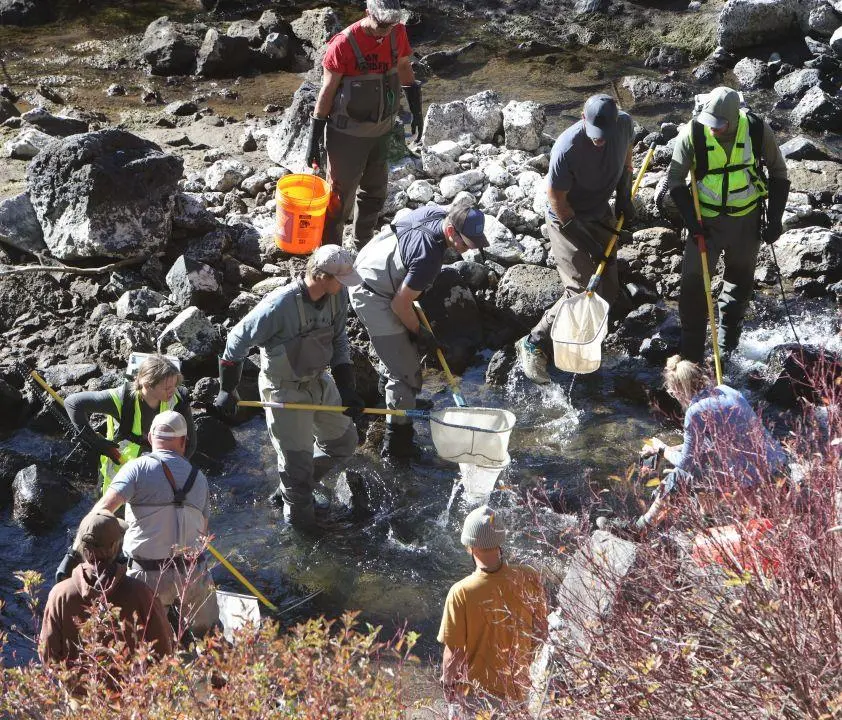
The Deschutes River Conservancy, a Bend-based nonprofit, steps in each year to organize the fish recovery effort. Volunteers sign up to help count fish or run them in buckets from the pools of water back to the river. Employees from Mount Hood Environmental use electroshock backpacks to temporarily stun the fish so they can be caught.
This year, 105 shifts were filled by 87 volunteers for a total of 449 volunteer hours, the Conservancy said.
“Each fall, irrigation districts, community volunteers, and partners come together to help the river,” said Kate Fitzpatrick, Executive Director of the Deschutes River Conservancy. “The partnership with irrigation districts to invest in modernization and flow restoration is bringing us closer to a future where it is no longer needed.”
The recovery effort this year was $33,422. North Unit Irrigation District and Central Oregon Irrigation District split the costs.
District officials say the annual fish rescue will eventually no longer be necessary because they plan to increase the winter flow to over 300 cfs in the coming years to improve the ecological habitat along the riverbanks for fish and frogs.
The plan to raise the winter flows is part of the Deschutes Habitat Conservation Plan, created by eight irrigation districts and signed at the end of 2020. The plan calls for the winter flows to rise by its seventh year, which ends in 2027.
But for the districts to increase the flow of the Deschutes in winter, they need to step up water conservation projects — namely the replacement of porous canals with pipes that won’t leak. Once canals are piped, the districts say, the conserved water can be used to increase the outflow from Wickiup in winter.
Photo: Volunteers collect fish that have become stranded in pools adjacent to the main channel of the Deschutes River during the Lava Island Fish Rescue west of Bend on Oct. 15. (Dean Guernsey/The Bulletin)
