
Redmond Spokesman: Redmond concerned about irrigation pipeline’s impact on groundwater
By Michael Kohn
Redmond is shifting from a potential legal challenge to a collaborative effort to address groundwater concerns as the Central Oregon Irrigation District moves ahead with plans to pipe 18.5 miles of the Pilot Butte Canal between Bend and Redmond.
The Redmond City Council decided this week not to pursue a legal challenge to the project’s environmental impact statement, instead seeking to work with irrigation districts and other basin partners on a program to replenish groundwater, according to a letter from Mayor Ed Fitch to irrigation district officials.
ShanRae Hawkins, a spokesperson with Central Oregon Irrigation District, confirmed to The Bulletin that there is no legal dispute between the irrigation district and the city.
The proposed approach could involve directing some winter water releases from the Deschutes River to areas where the water could seep into the ground and replenish the aquifer that supplies Redmond and rural residents with drinking water.
The proposal remains in its early stages, however, and its feasibility has not been evaluated by the state.
“We are involved in ongoing discussions with basin partners,” said Jason Cox, a spokesperson for the Oregon Water Resources Department. “An application for this project has not yet been filed so we have not yet done the analysis needed to assess the project’s feasibility.”
Piping impacts
The city’s decision follows weeks of discussions with Central Oregon Irrigation District, North Unit Irrigation District and other regional partners about the potential effects of piping the canal, which currently loses water through seepage into the ground. That water does replenish the underground aquifer that many residents and the city of Redmond taps for drinking water.
Redmond relies on groundwater and has raised concerns that reducing seepage — caused by piping the canal — could seriously affect the aquifer. The city has also been working to address state requirements related to groundwater management.
In his letter, Fitch said representatives from Redmond, COID and North Unit met Oct. 13. The City Council later heard public comments from North Unit patrons, and a city delegation met with state representatives in Salem. Fitch described that meeting as positive and said the city was cautiously optimistic about the discussions.
Redmond has also discussed the issue with other Central Oregon cities, the Deschutes River Conservancy, the Confederated Tribes of Warm Springs and commissioners from Deschutes and Jefferson counties.
The Central Oregon Cities Organization and consultants from GSI Water Solutions are expected to work with irrigation district representatives and other basin partners to develop a memorandum of understanding, Fitch wrote. The city hopes the agreement will help the partners pursue grant or legislative funding for an aquifer recharge study.
Under the concept discussed by the city, some water that North Unit is required to release during winter to support Oregon spotted frog habitat could potentially be routed to locations where it would infiltrate the ground and help replenish the aquifer.
Fitch estimated that the effects of canal piping could emerge over three to five years. The city hopes a recharge effort could help stabilize groundwater levels, protect domestic wells in Deschutes and Jefferson counties, and help Redmond meet its obligations under state law.
Delay warning
The canal modernization project is intended to reduce water losses and improve the efficiency of irrigation deliveries. But North Unit Irrigation District officials have warned that delaying or halting piping could affect farmers who depend on conserved water from projects in the Deschutes Basin.
North Unit serves more than 950 irrigators and about 59,000 acres of farmland in Jefferson County. Its growers produce specialty crops, including hybrid carrot seed, according to district General Manager Josh Bailey.
As a junior water-right holder, North Unit relies heavily on Wickiup Reservoir and is vulnerable to water shortages. Earlier this month, Bailey told Redmond City Council members that conserved water from COID piping projects, along with piping in other districts, is expected to be shared with North Unit and other junior water-right holders.
The water savings will improve water availability for farmers. It also helps North Unit make more water available for winter flows in the Upper Deschutes River, which are required under the Deschutes Basin Habitat Conservation Plan, intended to protect the Oregon spotted frog and fish.
North Unit must increase winter releases from Wickiup Reservoir under the plan regardless of whether additional conserved water is available. Without that water, Bailey said, farmers could face greater shortages while the district’s environmental obligations remain unchanged.
“We do believe there are solutions worth exploring, including opportunities for aquifer recharge, and allocating conserved water to help meet municipal needs,” Bailey told the council. “These changes require collaboration, not litigation.”
Bailey urged the council not to pursue litigation that could halt or delay COID’s piping projects, saying farmers, communities and the environment all depend on continued progress.
Farmers, ranchers and Jefferson County Commissioner Seth Taylor also raised concerns to city council at the meeting earlier this month.
Millions secured
COID has secured $66.9 million for the Pilot Butte Canal Modernization Project, including $25 million through the U.S. Department of Agriculture’s Natural Resources Conservation Service Regional Conservation Partnership Program. Another $5.9 million is sourced from the state of Oregon and $21 million comes from the Inflation Reduction Act funding, according to Hawkins, the COID spokesperson.
The district also has $15 million in USDA funding, pending final contract execution, which Hawkins said was anticipated within 90 days.
COID General Manager Craig Horrell said the district has already spent $42 million on Pilot Butte Canal piping that has been installed. That work has been completed near Redmond.
“As with all grants, we need to spend what we have before we can ask for additional funds,” Horrell said. “We continue to work hard to ensure that the funds we have been utilizing continue to be available.”
The project’s final environmental impact statement was published in August. The Natural Resources Conservation Service was expected to issue a record of decision before the end of the year, Hawkins said.
COID anticipated ordering pipe for the project in November or December and beginning portions of construction as approvals allow.
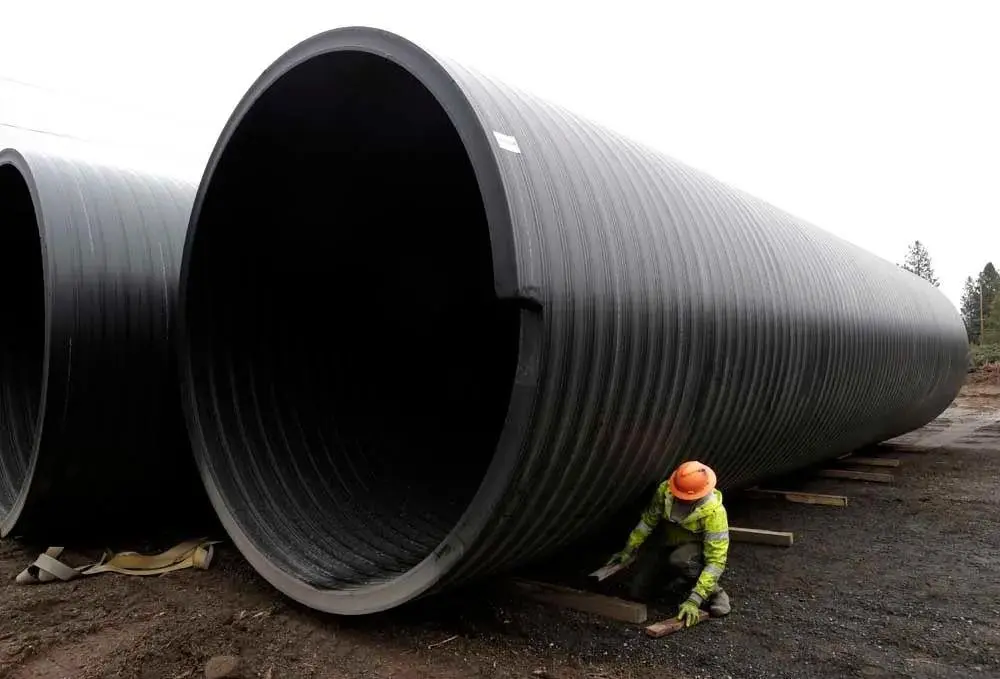
Photo: A worker places wood blocks underneath a piece of pipe that will be installed as part of the Central Oregon Irrigation District canal piping project near Brookswood Boulevard in 2018. (The Bulletin/ File)
