
Sisters Nugget: River interrupted: salmon and the Metolius
River interrupted: salmon and the Metolius
The Metolius River is believed to owe its Native American name to the Spring Chinook salmon which once spawned and died there in such numbers to earn it the moniker "Stinking Water." For thousands of years tribes of the region came to the Metolius to fish, hunt, gather, and honor their spiritual relationship with the river.
Small salmon called smolts made an epic journey of about 500 miles from the spring-fed Metolius where they were born, to the Deschutes, down the Columbia, to the Pacific Ocean. They spent a couple of years there, feeding and growing. Then overcome by some mysterious impulse they headed back again towards the Metolius River's icy waters, arriving in May and June to spawn and restart the cycle of life.
Historical accounts tell of abundant salmon in the Metolius River. In the winter of 1843, Native American guides told John C. Fremont the Metolius was "salmon water" as the explorer admired fish traps. In 1855, Army Engineers Henry L. Abbot and Robert S. Williamson bought a 25-pound salmon speared by native fisherman using detachable iron spearheads tethered to 8-foot poles.
The huge runs of these migratory salmon and steelhead were part of nature's gift to the Columbia River Basin where some studies estimate 10 to 16 million adult fish returned annually to spawn before Euro-American settlement in the mid 1800s. With that settlement came new industries, fishing fleets, traps, and salmon canneries on the Columbia. The first cannery was built in 1866 and by the 1880s there were 30-50 canneries lining the lower Columbia and its tributaries. There were so many salmon, few believed they could ever disappear.
However, the harvest was intensive, and salmon runs began to decline as early as the 1870s. Habitat loss added to the problem. Some people were worried the runs would collapse which led to talk of a scientific solution, hatcheries, to artificially propagate fish by collecting eggs, fertilizing them, and releasing millions of small fish to replace those harvested. Like many things, it was a compromise to maintain and offset the impacts of the successful fishing and canning industries while conserving fish populations. The first hatcheries on the Columbia were built in 1878 and by the 1890s millions of young Chinook salmon were being released to replace those harvested.
Meanwhile, business interests in Portland were drawn to the agricultural potential of Central Oregon and its benefits to shipping, banks, and commerce in the Portland hub. In 1912, the Portland Chamber of Commerce asked the federal government to fund a study of irrigation opportunities in the Deschutes Basin. U.S. Geological Survey engineers reportedly walked much of the Deschutes canyon from the Columbia River to Bend, as well as the tributaries, to identify possible dam sites where water could be stored for irrigation, to reclaim the arid west.
The resulting 1914 study by Fred F. Henshaw et al. identified 14 possible dam sites on the Deschutes and four sites on the Metolius. During the 1920s-40s optimism on the potential of irrigation faded while conflicts developed over the future of agriculture, hydropower, and fisheries. Bonneville Dam, completed in 1938, was starting to affect the runs, although it had a fish ladder. Hatcheries to offset the declining runs on the Metolius were built on Spring Creek, a tributary of the Metolius, and later at Wizard Falls in 1947. But the runs continued to decline. In 1951, 765 spawning Chinook were seen. In 1953 there were 512.
The Pelton site on the Deschutes was proposed for a hydro dam in the late 1940s and was licensed in 1951. A legal challenge from the State of Oregon argued the dam would block salmon and steelhead from their spawning areas. The fight reached the Supreme Court and Oregon lost. The Pelton Dam was completed in 1958. To generate more power, Round Butte Dam was built in 1964, and the Reregulating Dam shortly after.
There was a mitigation plan to provide fish passage. A 2.8-mile fish ladder brought adult fish from below the Reregulating Dam, past Pelton Dam, up to Lake Simtustus. At the time it was built, it had the honor of being the longest fish ladder in the world. There was also a fish tram, an aerial lift, to move adult salmon over Round Butte Dam, which was too high to have a ladder. There were collection facilities for young fish as they headed downstream.
But the story of what happened next is NOT like the kid's joke, "What did the fish say when he hit the wall? Dam!" The ladders and trams for the adult fish headed upstream from the ocean worked to some degree. It was the young salmon that found trouble. Smolts got lost in layers of cold and warm water from the three river tributaries. They were trapped in the quiet lake behind the dam without a helpful current to ride to the collection area for passage to the sea. By the late 1960s the runs of chinook and sockeye salmon and steelhead were gone from the Upper Deschutes Basin. The last spawning Chinook in the Metolius River was recorded in 1967. The mitigation program ended in 1968, and the fish ladder and other facilities were mothballed.
But many people still dreamed that the salmon and steelhead runs on the Deschutes, Metolius, and Whychus would return someday. Technology, social will, and momentum grew during the Federal Energy Regulatory Commission relicensing of the three dams. In an extraordinary collaborative effort over a decade, the co-owners, the Confederated Tribes of Warm Springs and Portland General Electric, Oregon Department of Fish and Wildlife and many partners agreed to a new plan for fish reintroduction in 2004. Successful passage downstream resumed in 2010, after more than 40 years.
The Metolius River provides most of the spring Chinook salmon habitat in the upper Deschutes River Basin. This summer adult Chinook are being released near Camp Sherman to turbo charge the reintroduction process. Keep an eye out for these iconic fish, who have survived, despite challenges, false hopes, and our technological hubris. May future generations be able to witness the end of their journey between river, sea, and home.
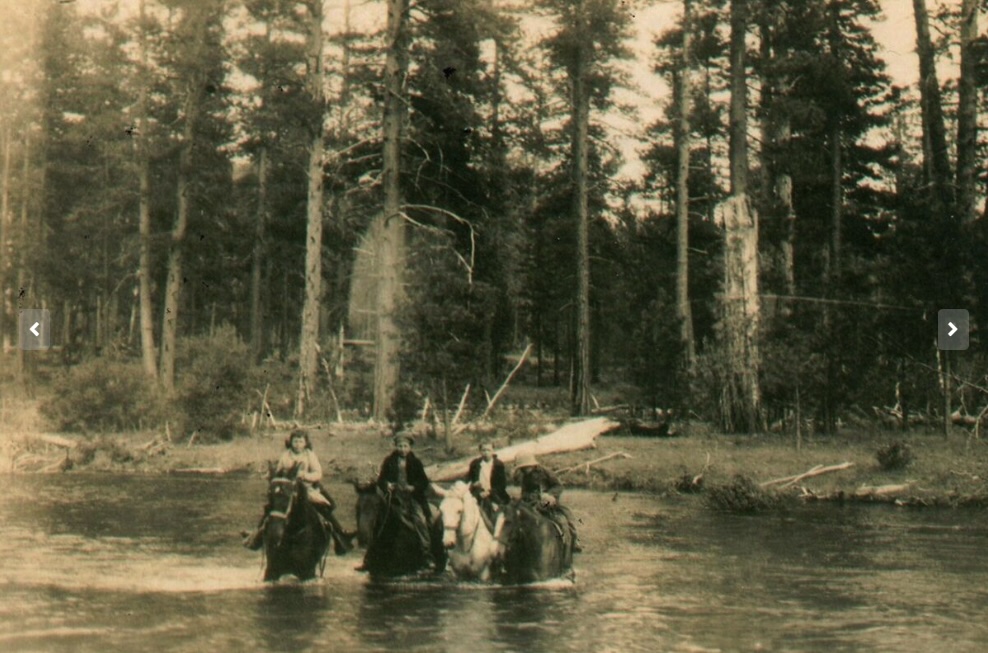
Cover photo: Sherman County children riding across the Metolius River, 1917. Photo courtesy USFS
